


According to the data presented by the Cybernews team, Grindr and Bumble are some of the most data-hungry dating apps out there, while Hinge, Match, and Tinder could be your pick if you’re looking for privacy.
Apps collect sensitive information such as sexual orientation
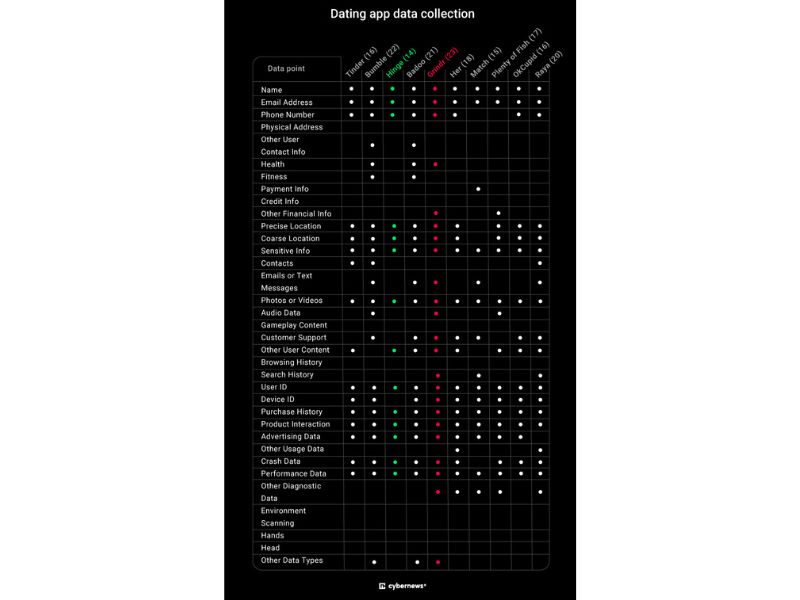
Six out of 10 apps collect some data that could be used to track users across apps and websites owned by other companies or shared with a data broker. All apps noted they collected information about the user’s photos and videos, as well as sensitive information such as sexual orientation.
For example, Badoo users could expect their data across seven categories shared with third parties, including precise location, coarse location, email address, device ID, advertising data, other user contact data, and other data types. Meanwhile, Her app is an outlier on the list in that it tracks most of the data it collects about its users and links it to their identity.
How is the collected data handled?
While most users’ personal data is necessary to keep the app running, some are also used for advertising and may even be shared with third parties, apps, and websites owned by other companies.
All of the reviewed apps disclosed that they collect data, which they link to user identity. Apps can also identify data that they collect but do not link to user identity – four out of the list did just that.
Which dating apps collect the most data?
Below is the list of 10 popular dating apps based on how much data they collect, ranked from the most data-hungry to the least. There are 35 types of data or privacy points that Apple requires developers to disclose if their app is collecting – you can see them in the attached visual.
1. Grindr – 23 collected, 2 tracked
It is the most data-hungry dating app on this list, collecting 23 points of data about its users for various reasons, including app functionality, analytics, and advertising. It links all of the collected data to user identity and tracks two types of data, namely device ID and advertising data, which it can share with other companies.
2. Bumble – 22 collected, 4 tracked
The app is second on the list of the most data-hungry dating apps, collecting user information across 22 data categories. All of the collected data is linked to user identity and used for analytics, third-party and own advertising, product personalisation, and app functionality. Bumble also tracks user data in four categories, namely, coarse location, email address, device ID, and advertising data. All could be shared with apps and websites owned by other companies.
3. Badoo – 21 collected, 7 tracked
Badoo collects 21 types of data that it links to user identity to keep the app functional, as well as for its own and third-party advertising. It is also among the apps that track the most user data. Badoo users could expect their data across seven categories shared with third parties, including precise location, coarse location, email address, device ID, advertising data, other user contact data, and other data types.
4. Raya – 20 collected, 0 tracked
According to Raya, the app does not track users, meaning their data may not be shared with third parties. It still collects 20 types of data about its users that it links to their identity for app functionality and product personalisation reasons, as well as analytics and advertising.
5. Her – 18 collected, 4 not linked, 8 tracked
It is an outlier on the list in that it tracks most of the data it collects about its users and links it to their identity. Out of 14 data types collected and linked to user identity, eight may be shared across apps and websites owned by other companies, including purchase history, precise location, coarse location, email address, phone number, user ID, device ID, and advertising data.
Overall, Her collects 18 different types of data for various purposes, but four of those are not linked to user identity, namely, crash data, performance data, other user data, and other diagnostic data.
6. Plenty of Fish – 17 collected, 2 not linked, 0 tracked
In terms of privacy, it collects 17 types of data about its users. Of those, two are collected but not linked to user identity, which is advertising data and performance data. According to the privacy practices provided by Plenty of Fish, the app does not track its user data, meaning it should not be shared with other companies.
7. OkCupid – 16 collected, 3 tracked
OkCupid tracks its users’ purchase history, device ID, and product interaction, which may be shared with other apps and websites. Overall, the app collects 16 different data types, which it links to user identity. The app says it uses most of the data it collects for its own advertising and marketing, analytics, app functionality, and product personalisation, as well as third-party advertising.
8. Tinder – 16 collected, 0 tracked
It collects 16 types of data that it links to your identity, which it mainly uses for analytics, product personalisation, and app functionality. Some of that data is also used for third-party advertising, as well as the app’s own marketing, but none of the information collected by Tinder is shared with third parties, according to the app.
9. Match – 15 collected, 3 not linked, 1 tracked
Match is also less intrusive when it comes to user data. Out of the 15 data points it collects about its users, the app only links 12 of them to their identity. Product interaction data, crash data, and performance data are collected but not linked to user identity. It tracks one type of user data, which is the device ID.
10. Hinge – 14 collected, 2 not linked, 0 tracked
Among major dating apps, Hinge may be the best choice for privacy-minded individuals. It collects user data across 14 types of data, which it says it only uses to improve the app’s performance and for its own marketing purposes. It links most of the data it collects to the user identity, except for crash data and performance data, which are not linked. The app does not track user data.
Methodology
To see what user data apps collect and what they do with it, the Cybernews team reviewed 10 popular dating apps based on their privacy practices disclosed on the App Store as part of Apple’s privacy requirements.
As it stands at the time of publishing, there are 35 types of data or privacy points that Apple requires developers to disclose if their app is collecting. These include contact information like name or phone number, financial information like payments or credit, and user location.
Developers are also required to list data that the app links to the user. According to Apple, such data is collected in a way that is linked to user identity, such as their account, device, or details like phone number.