

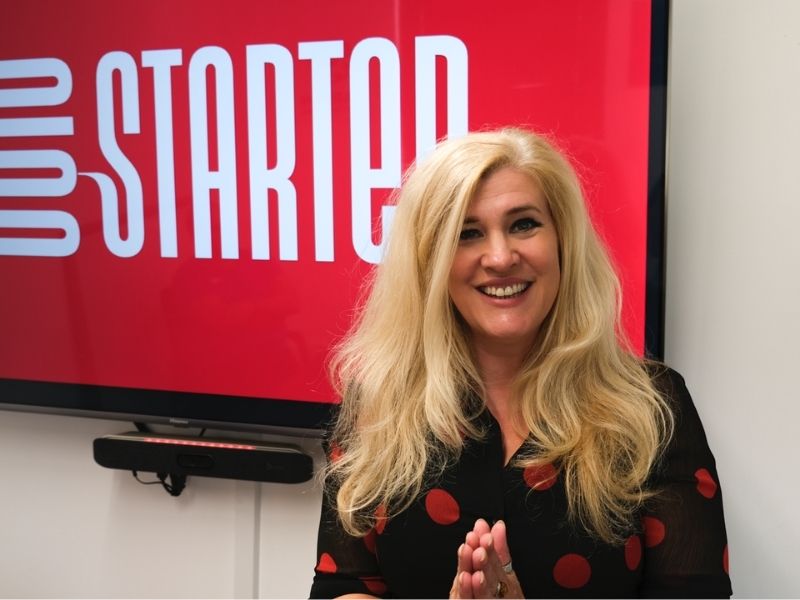
Mickey Wilson is the CEO and Founder of Firestarter, a brand consultancy that fuses creativity and psychology to help B2B businesses stand out, scale, and create lasting impact.
With over 30 years’ experience, Mickey launched her first agency at just 21 and has since worked with global brands including Samsung, Tesco and CIMA, as well as ambitious start-ups and scale-ups.
She developed the DARE Formula – a powerful framework for building brands that are differentiated, authentic, resonant and consistently expressed. Mickey runs Firestarter with co-founder and business psychologist Dr Chris Endersby, and together they are co-authors of the upcoming book BRANDFIRE.
You launched your first agency at just 21 years old. What did that experience teach you about confidence and backing your own ideas early in your career?
At 21, I wasn’t necessarily confident, but I was incredibly excited about starting my own business – and luckily, that blitzed the self-doubt. Looking back, I was probably “faking it till I made it” – even though I hadn’t heard that phrase back then. But now, I realise that’s the only way many of us can start. And it works.
So outwardly, I projected confidence. But, inwardly, it was a different story. I left home at 16 and never went to uni. Without a degree to fall back on, I had to put everything into the work to prove myself. I’d obsess over every detail and work around the clock until I was convinced the creative output was as ingenious as I could make it. And then I’d literally quake on the inside when I pitched it.
It took years of experience to build real confidence. To realise that it doesn’t come from getting it right first time. It comes from putting something you believe in out there, learning from it, and doing it again. Published beats perfect – every time.
Across three decades in branding, what’s changed most in how businesses build meaningful connections with their audiences?
Everything. Technology. Culture. The way we do business. The way we communicate.
When I started out, everything was print-based and more formal, and it took forever to get anything into the hands of the customer. Businesses relied heavily on agencies for everything brand-related. And people rarely knew the founders behind the business.
Now it’s the opposite. Businesses can control their own brand and marketing. They’re publishing constantly, in real time. And founders are usually at the forefront of their brands.
What used to be considered “professional” can now feel inauthentic. Instead, people connect with brands that are transparent and real. Brands no longer build connection from a distance. They build it up close. And yet human nature hasn’t changed. We still buy from companies we know, like and trust. That was true thirty years ago, and it’s just as true today.
You talk about turning originality into lasting influence. What does that look like in practice for a growing business today?
I can’t see any other way to create lasting influence. If your ideas, products or services are like everyone else’s, you’re just one of many voices saying the same thing. And people switch off.
Originality gives people a reason to tune in. And it doesn’t have to mean reinventing everything. No one has lived your life or learned what you and your team have learned in quite the same way. That gives you a perspective no one can replicate.
When you uncover that – usually rooted in what you’re both deeply skilled at and genuinely passionate about – you create something fresh. A clear point of view. And that goes a long way to attracting the believers you need to build lasting influence.
The DARE Formula sits at the heart of Firestarter. Which of those four elements do businesses struggle with most, and how can they start strengthening it?
DARE stands for Differentiation, Authenticity, Resonance and Expression. And Differentiation, undoubtedly, is the one people struggle with most. Because it asks you to bravely step away from what feels normal and accepted within your industry. And that’s hard. As humans, we’re wired to fit in, not stand apart.
It also requires focus. Real differentiation means committing to a single, compelling idea and building everything around it. And that feels risky. Founders worry about narrowing their appeal or getting it wrong.
But when you try to be everything to everyone, people have a hard time believing you. When you commit to a genuine difference – and express it consistently – you become recognisable, memorable and far more credible.
You’ve worked with global brands and scale-ups. What separates brands that truly stand out from those that blend into the background?
It’s easy to differentiate your brand design and messaging. And those things matter – but only when they’re expressing something real underneath.
Brands that blend in look outside for the answers – benchmarking themselves against competitors, following category norms, adopting the same trends – and they end up being interchangeable.
The brands that truly stand out have done the deep work. They’re clear on why they exist, what they stand for, and they know their customers well enough to solve their problems in ways others don’t. They build their brands from the inside out, and everything aligns.
As AI becomes part of content creation, how can founders maintain originality and keep their brand voice human?
This comes down to what we call the first and last mile. Founders should absolutely harness AI. In many ways, they can’t afford not to. But there are two things that should never be outsourced.
The first mile is your thinking – your perspective, your ideas, your point of view. That’s where your originality lives.
The last mile is quality control – ensuring the content actually sounds like you, reflects your standards, and aligns with your brand.
AI can do miracle work in the middle. But it should never own the edges – that’s where the value is created.
You’ve described authentic differentiation as creating freedom. What kind of freedom should founders be aiming to build through their brand?
Most founders start a business to generate freedom – but few build brands that actually deliver it. That’s where DARE comes in.
Differentiation creates freedom of money – when your brand is built on unique value, you stop competing on price.
Authenticity creates freedom of purpose – you build around what you believe and the impact you want to make.
Resonance creates freedom of relationships – you attract the right people for all the right reasons.
Expression creates freedom of time – when your brand is clear and consistent, you no longer have to be in every room.
For leaders who feel stuck or unsure about their brand direction, what’s the first step you’d encourage them to take?
It’s tempting to aim for a quick fix with some new messaging or a refreshed logo. But if you feel stuck, it’s usually a sign you haven’t done the inside work yet.
So the first step is to pause and get really honest. Not about your logo or your website – but about what sits underneath. Ask yourself questions like: What do you actually believe? What do you care about above all else? What have you learned that others haven’t? Who are your ideal customers? What do they care about most? And why?
Most brand challenges aren’t surface-level problems. They’re depth and clarity problems. And once you have that clarity, direction becomes much easier to find.
Your upcoming book, BRANDFIRE, focuses on helping leaders unlock their ideas. What inspired you to write it, and what do you hope readers take away?
For years, we talked about turning our thinking into a book. The more we worked with different clients, the more we learnt. The deeper we went, the more we closed the loops. We always knew we had a book in us – but we were too busy doing, and having far too much fun, to actually write it.
Then the world began to change. AI and automation – and soon robotics – are threatening jobs, businesses and entire industries. Suddenly, it isn’t just about building a good brand – it’s about staying relevant and irreplaceable in this new world.
That’s when the book became urgent.
BRANDFIRE helps founders and leaders take what’s in their heads – their ideas, their instincts, their experience, their value – and turn it into something clear, distinctive and commercially powerful.
Ultimately, we want readers to walk away with one thing – the agency to build a brand (and business) that can’t be replaced.
Looking ahead, what excites you most about the future of branding, and where do you see the biggest opportunities for bold thinking?
Despite everything I’ve just said, AI genuinely excites me – especially for early-stage founders. For the first time, they don’t need huge budgets and large teams to build an impactful brand. They just need the knowhow. And that opens the door to real creativity. If founders use AI as an amplifier rather than a shortcut, we could see some of the most exciting brands we’ve ever seen.
As for bold thinking, it starts with going deeper. Understanding your customers and what’s really driving them. Challenging your assumptions. Questioning how things are done in your industry.
The most original thinking happens when you close the browser and let your mind work. It feels uncomfortable. But in a world of increasingly superficial brands, the ones that think more deeply and meaningfully will be the ones that last.
Looking for more conversations like this? Head to our Inspirational Women stories section to read more from founders and leaders sharing their experiences.