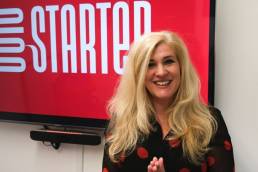


Georgina Badine also known as “Gigi” is a London-based confidence and career coach, and the founder of Invicta Vita.
After 14 years in high-level finance roles at Barclays, Arbuthnot Latham, Sandaire and the Real Estate Investment Office, Gigi transitioned to coaching, specialising in public speaking, imposter syndrome, and workplace empowerment. With a deep understanding of business and human behaviour, she helps clients build confidence, assert themselves, and navigate challenges like, bullying, stress around performance reviews and interviews as well as how to stand out from the crowd.
Originally from Geneva, Gigi holds an MSc in Management from Imperial College. Her empathetic and strategic approach has made her a trusted guide for professionals seeking purpose, resilience, and authentic self-leadership.
Tell us about yourself and your background, and what first drew you into finance and wealth management.
In my late teens and early twenties, I actually wanted to be a journalist and most of my internships reflected that as I love to write and I’m naturally inquisitive. After an internship in private banking in Geneva, my vision changed slightly and I saw banking in a different light, one more focused on people and I always enjoyed human connections and interacting with others. Banking seemed to offer both the intellectual stimulation of journalism, combined with the social interactions that I thrived on. After being approached by the head of graduate recruitment of Barclays at Imperial College, I was encouraged to apply and the rest is history.
You spent 14 years building a high-flying career at Barclays and in private wealth management. What helped you rise through the ranks, starting from the bottom?
This was a mixture of factors. The first was strong work ethic as you really have to prove yourself and need to be prepared to put in the work. I also learnt how to network effectively, both within the organisation and outside of the organisation. It wasn’t enough to just be technically strong, people had to know who you were in the organisation, reputation was key. I also quickly learnt the power of having a good mentor who could guide me and help me learn and develop. I had a number of mentors throughout my career and I am very grateful to them for helping me develop and progress. I think everyone should have a mentor who can help challenge them and offer strategic guidance.
You’ve spoken about the hyper-masculine culture in parts of the finance industry. What did you learn about yourself while navigating that environment?
I learnt that I was strong and that I wanted to help change a system that is so antiquated in my view. Whilst I would talk back and sometimes be branded as too vocal or difficult, I never went public during my time and I look back on that and hope that others feel empowered to speak up against a system that is broken. We should all feel safe and comfortable at work. Gender should not determine who gets promoted. I also learnt that if I wanted to change things, I should help others find their voice by accompanying them throughout any bullying, sexual harassment or discrimination they may be facing.
At what point did you realise your role was becoming more than finance, and that you were also becoming a career mentor and advocate?
A client approached me about his daughter. She had started working at an organisation and was deeply unhappy. He was struggling to understand why she was so unhappy as she wouldn’t speak to him. He then asked if I could speak to her and offer some career advice. We met and she soon told me that she was being bullied at work and crying on a regular basis. I told her she needed to report it and move to a less toxic organisation. I helped her to apply to other organisations and she landed one of the roles. Her father was relieved and he told me that I should consider becoming a mentor as I was so helpful and reassuring. I felt a really energy from helping her and others started to ask for my help.
Clients started asking you to support their children with career progress, CVs and cover letters. What do you think they saw in you that made them trust you with something so personal?
I think they saw I was personable, yet strong and that I had a clear sense of direction. They felt I was someone who was very clear about how to navigate the corporate world and that my experience in such a high- pressured environment would be helpful to their children.
You were also a quiet advocate for colleagues, including men, who were struggling mentally. What made you step into that space, and what did it teach you about leadership?
I saw men who were bullied, one experienced clear racism and one was constantly put down by his boss. I stepped into that space as I feel men struggle to talk about bullying even more than women as they feel it makes them look weak. I realised that men also need a safe space where they can voice their struggles. Bullies often try to mask it as banter but there is a clear demarcation between the 2.
What was the turning point that made you found Invicta Vita, and what did it take to leave a secure career behind to build something of your own?
When I left banking, I joined another business specialising on helping young people find careers. The ethos of that business didn’t really match mine and I felt that I needed to build something that was authentically me. I then realised that people actually wanted to help me once it was my own business as they valued my approach and vision. Whilst I am very grateful to what banking offered and taught me, I was ready for the next chapter in my journey and that was more focused around helping others.
Invicta Vita supports student to 40+ career transitioners. What patterns do you notice in the way people talk themselves out of change, and how do you help them move past that?
A lot of people are scared to take that leap or to pivot. I help them realise that it is all centred around values. If your values are not aligned with your place of employment, then it will never work. Sometimes, the change is simply moving company, sometimes it requires a bigger shift and an industry change. I get my clients to think about what makes them excited and empowered and then that leads to a lot more clarity in terms of where they end up.
In your work, what are the biggest career confidence issues you see in women specifically, and what helps shift that fastest?
A lot of my female clients struggle to put themselves forward for a promotion or to ask for a salary increase as they are afraid of being labelled as aggressive, difficult or delusional. I always say that if you don’t put yourself forward, then you won’t be taken seriously. I have been told countless times that I wasn’t ready or that it was too soon for me. Whilst experience is important, I do find that there is often a narrative of women being aggressive if they ask for more, whilst men get told they are assertive which is much more positive language. Yes, you need to earn your stripes but you also need to put yourself out there if you want to progress. Promotions are rarely just handed to you.
For someone who feels stuck, burned out or afraid to pivot, what’s the first step you’d recommend to start rewriting their career story?
My recommendation would be to get a mentor who is completely objective and external to your company as they will have no conflict of interest. Talk to someone who is completely objective who can help you map out the next stage of your life. Make a list of what you are good at and what you are not good at as that’s really helpful for looking at where to move on to. Think clearly about what is non-negotiable for you as well as what you enjoy about your current role. I also recommend speaking to people in your network who work across different sectors to get a better understanding of what the job entails to see if it’s potentially a good fit.